Cute School Supplies for Back to School: A Strategic Creative Asset for Modern Makers
For creators, small business owners, and digital product designers, the seasonal rhythm of back-to-school isn’t just a retail event—it’s a creative inflection point. Each August, demand surges not only for notebooks and backpacks, but for customizable, emotionally resonant design assets that reflect evolving aesthetics, values, and production workflows. At the center of this shift sits Cute School Supplies for Back to School: a purpose-built digital graphic collection designed not as passive decoration, but as a flexible, production-ready toolkit for sublimation printers, Cricut enthusiasts, sticker entrepreneurs, and print-on-demand professionals.
More Than Just “Cute”—A Response to Shifting Creative Expectations
The phrase “cute school supplies” may evoke pastel erasers or kawaii-style pencil cases—but today’s interpretation is far more nuanced. It reflects a broader cultural pivot toward intentional personalization, where consumers—especially Gen Z students and millennial educators—seek products that balance playfulness with authenticity, whimsy with utility. This isn’t nostalgia-driven fluff; it’s a deliberate aesthetic strategy rooted in emotional resonance and visual cohesion.
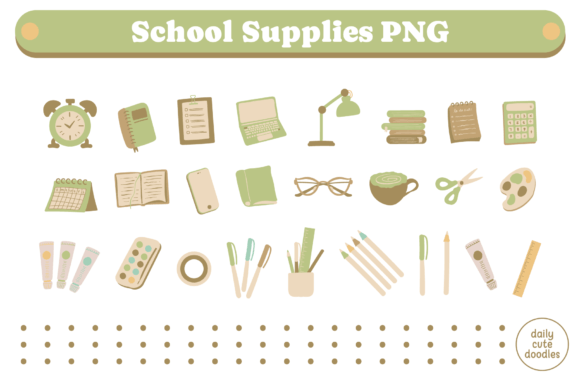
Consider how classroom branding has evolved: teachers now curate Instagram-worthy bulletin boards, homeschoolers design themed learning kits, and student-led clubs commission custom merch for spirit weeks. In parallel, small-batch craft businesses are moving beyond generic clipart toward high-fidelity, stylistically unified assets that support brand consistency across physical and digital touchpoints. Cute School Supplies for Back to School meets this need precisely: 26 meticulously crafted PNG files—each at 300 DPI with transparent backgrounds—offer the resolution required for crisp sublimation transfers on tumblers and tote bags, the clarity needed for intricate Cricut weeding, and the scalability essential for sticker sheets sold on Etsy or Shopify.
Why Transparency, Resolution, and Format Matter—Operationally
In practice, “no watermarks” isn’t just a marketing promise—it’s a workflow imperative. When you’re batch-producing 50 custom pencil pouches for a local tutoring co-op or prepping 200 vinyl decals for a school fundraiser, time spent manually removing overlays or resizing low-res graphics directly impacts margins and turnaround. The inclusion of transparent-background PNGs eliminates layer-masking steps in design software like Cricut Design Space or Adobe Illustrator. Likewise, 300 DPI ensures sharp edges when printed at 2" x 2" (ideal for planner stickers) or scaled up to 8" x 10" for laminated classroom posters—without pixelation or interpolation artifacts.
This technical precision aligns with industry-wide shifts toward production-grade digital assets. Unlike free download sites that prioritize volume over viability, curated collections like this one assume professional use: consistent line weight, balanced negative space, intentional stroke contrast, and color palettes optimized for both screen viewing and CMYK/RGB output. For example, the notebook icon includes subtle paper texture overlays—not as visual noise, but to enhance tactile perception when printed on matte sticker stock. That level of detail doesn’t slow down output; it accelerates trust in the final product.
From Sublimation to Sticker Sheets: Real-World Application Scenarios
Let’s ground this in action. A freelance educator launching a summer STEM camp might combine the “science beaker” and “rocket pencil” graphics into a cohesive welcome kit—sublimated onto reusable water bottles and heat-pressed onto cotton drawstring bags. Because all files share the same stylistic language (soft rounded corners, gentle shadowing, harmonized line thickness), the resulting kit feels branded—not assembled.
Meanwhile, a micro-business owner specializing in teacher appreciation gifts could use the “apple with glasses” and “stacked books” icons to build a layered SVG cut file for a vinyl decal set. The transparency allows precise layering over textured vinyl backgrounds; the resolution ensures clean cuts even on intricate details like book spines or apple stem curves. No additional vector conversion is needed—saving hours per project.
And for digital-first creators? These files integrate seamlessly into Canva templates for printable planners, Google Slides for virtual classroom decor, or Notion dashboards for student goal tracking. The absence of watermarks means no legal friction when reselling derivative digital products—provided usage adheres to standard commercial licenses (always verify terms).
Aligning With Broader Industry Movements
This collection gains relevance within three converging trends:
- The Rise of Micro-Branding: Consumers increasingly favor small, values-aligned makers over mass retailers. Custom school supplies—personalized with names, subjects, or inside jokes—signal care and attention. Cute School Supplies for Back to School empowers creators to deliver that specificity at scale.
- Hardware Democratization: As sublimation printers drop below $300 and Cricut machines become standard in home offices, the bottleneck shifts from equipment access to quality source material. High-resolution, production-optimized graphics fill that gap.
- Sustainability Through Longevity: Rather than disposable trend-based designs, these illustrations follow evergreen visual principles—balanced proportions, restrained color saturation, and scalable simplicity—ensuring reuse across multiple academic years and product categories.
It’s also worth noting how this asset type supports inclusive education practices. The set avoids stereotyped representations—no gendered color coding, no culturally narrow motifs—and instead leans into universal symbols (backpacks, globes, lightbulbs) rendered with warmth and clarity. That neutrality makes it adaptable across diverse curricula, international markets, and neurodiverse learning environments.
Workflow Integration: How Professionals Actually Use It
Practical adoption looks different across roles—but the thread is consistency and speed. A marketer building a back-to-school email campaign might drop three icons into a Mailchimp template alongside copy about “learning tools that spark joy.” A Cricut user preparing for a craft fair might import six files into Design Space, group them by size, and generate a single mat layout—cutting setup time by 70% versus sourcing disparate elements.
For freelancers offering design-for-hire services, this collection functions as a premium starter kit: clients receive polished, cohesive deliverables without requiring custom illustration time. That translates to faster quoting, tighter deadlines, and higher perceived value—all while maintaining creative control through mix-and-match flexibility.
Crucially, the ZIP delivery format supports modern cloud-based collaboration. Files sync instantly to Dropbox or Google Drive, enabling real-time feedback loops between designers, printers, and clients—no version confusion, no missing layers.
Looking Ahead: Design Assets as Infrastructure
As generative AI accelerates asset creation, the value proposition of hand-crafted, context-aware design libraries only strengthens. Algorithms produce quantity; humans curate quality, intention, and interoperability. Cute School Supplies for Back to School exemplifies this next-generation infrastructure: not a standalone graphic, but a modular system built for longevity, compatibility, and expressive range.
Its relevance won’t fade with the calendar—it will compound. Teachers will reuse icons year after year in updated lesson plans. Entrepreneurs will repurpose stickers as social media story highlights or packaging accents. Designers will blend elements with original typography or photography to create proprietary brand extensions.
In short, this isn’t seasonal inventory. It’s foundational creative capital—delivered cleanly, thoughtfully, and ready for impact.
Thank you for dropping by, dailycutedoodlesฅ •ﻌ• ฅ.