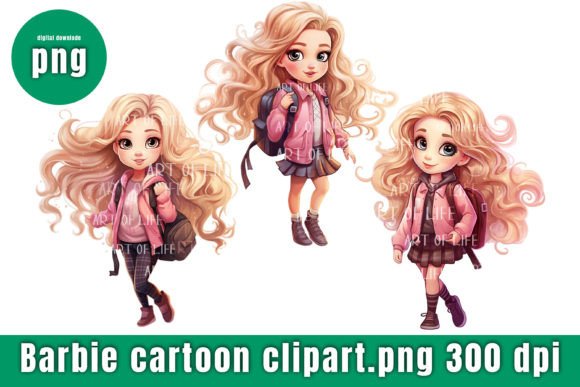
Cartoon Cute Girl Back to School: A Versatile Digital Asset for Creative Educators and Designers
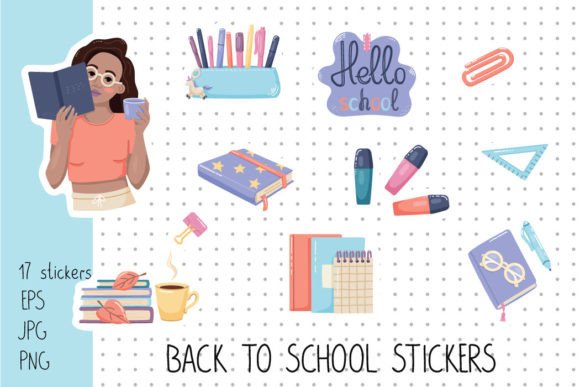
When educators, small business owners, and DIY crafters seek joyful, age-appropriate visuals for back-to-school season, the Cartoon Cute Girl Back to School digital asset pack stands out—not as a generic clipart collection, but as a thoughtfully engineered creative toolkit. Its appeal lies not only in its charming aesthetic but in its technical readiness for real-world production across diverse physical and digital applications. This article explores how this specific set functions in practice: what it contains, why resolution and file format matter, where it adds measurable value, and what users should realistically expect when integrating it into their workflows.
Technical Specifications That Enable Real-World Use
The pack delivers six high-resolution files—three PNGs and three JPGs—each sized precisely at 4000 × 4000 pixels and rendered at 300 DPI. This isn’t arbitrary sizing. At 300 DPI, the files retain crisp detail when printed at common physical dimensions: a 13 × 13 inch poster, an 8 × 10 inch greeting card, or even a 4 × 4 inch sticker without visible pixelation. The consistent square aspect ratio further simplifies layout planning across platforms—from Canva templates to Adobe Illustrator artboards.
The distinction between PNG and JPG formats serves functional purposes. The PNG files include transparent backgrounds, making them ideal for layered design work: placing the cartoon cute girl back to school illustration over custom gradients, textured paper scans, or classroom-themed photo collages. Designers embedding the image into SVG-based web interfaces—or applying CSS blend modes—benefit directly from alpha-channel support. In contrast, the JPG versions use a clean white background, streamlining use cases where background consistency is critical: printable worksheets, branded PDF handouts, or product mockups for print-on-demand platforms like Printful or Gelato.
Practical Applications Across User Groups
Different professionals interact with this asset in distinct ways—each leveraging the same core files for divergent outcomes.
Educators and Instructional Designers
In classrooms, visual consistency supports cognitive load theory: familiar, friendly characters reduce extraneous processing and increase engagement with academic content. A teacher might import the PNG version into Google Slides to create a “Back to School Bingo” board, overlaying editable text boxes on top of the illustration. Another may use the JPG variant in a printable “All About Me” student survey, where white-background compatibility ensures clean photocopying. For distance learning, the high-res files scale gracefully in LMS dashboards (e.g., Canvas or Moodle), remaining legible on tablets and interactive whiteboards alike.
Small Business Owners and Makers
Craft entrepreneurs selling custom school supplies often face bottlenecks in sourcing licensable, production-ready artwork. With this Cartoon Cute Girl Back to School set, a sticker shop owner can upload the PNG directly to their vinyl cutter software—no manual background removal needed. A boutique stationery brand might combine the JPG file with foil-stamped typography in Adobe InDesign to produce premium invitation suites for kindergarten graduation parties. Because both formats are raster-based (not SVG), they integrate seamlessly with most DTG (direct-to-garment) printer RIP software, avoiding vector conversion errors that plague scalable line art in fabric printing.
Hobbyists and Family Creators
Parents designing personalized first-day-of-school signs or printable classroom decorations benefit from immediacy and flexibility. The transparent PNG allows dragging the cartoon cute girl back to school character into free tools like Photopea or even Microsoft Word’s “Insert > Pictures” flow—with automatic background removal enabled via built-in AI tools. Meanwhile, grandparents compiling photobooks for grandchildren’s school years can drop the JPG into Shutterfly or Mixbook templates, confident the white background won’t clash with pre-designed page themes.
What This Pack Does Not Include—and Why That Matters
This is a digital download only. No physical items ship. No SVG files are provided. These omissions are intentional design decisions—not limitations.
- No physical delivery aligns with sustainability goals and instant access needs: a teacher preparing lesson plans at midnight receives usable assets within seconds—not days.
- No SVG files reflect realistic production constraints. While vector formats scale infinitely, they rarely translate cleanly to print-on-demand services optimized for raster input. Many apparel printers, for example, reject SVG uploads due to inconsistent color profile handling. Providing only PNG/JPG eliminates compatibility friction.
- No commercial redistribution license protects both creator and buyer: users gain broad usage rights for derivative projects (stickers, mugs, cards), but cannot resell the raw files as standalone clipart. This preserves market integrity while still empowering end-use creativity.
Color Accuracy, Output Variability, and Workflow Adjustments
Monitors display color using RGB; printers render using CMYK or proprietary pigment systems. As noted in the description, “Actual colors may vary slightly due to monitor settings. Colors and quality may vary depending on how your photos are printed.” This isn’t boilerplate—it’s a necessary acknowledgment of color science. A designer preparing files for offset printing should convert the JPG to CMYK in Photoshop and soft-proof against their printer’s ICC profile. For screen-based uses—digital newsletters or social media banners—the original sRGB embedded profile suffices.
Similarly, DPI alone doesn’t guarantee print fidelity. Paper stock matters: glossy finishes enhance vibrancy; uncoated matte stocks mute saturation. Users printing on home inkjets may see subtle banding unless they enable high-quality photo mode and select appropriate paper type in driver settings. These variables aren’t flaws in the asset—they’re inherent to cross-platform media production. Recognizing them enables proactive troubleshooting rather than blaming the source file.
Implementation Tips for Maximum Utility
To extract full value from the Cartoon Cute Girl Back to School files, consider these field-tested practices:
- Batch rename files immediately: Label them descriptively (e.g., “cartoon-cute-girl-back-to-school-png-transparent”, “cartoon-cute-girl-back-to-school-jpg-white”) to avoid confusion during large-scale projects.
- Test print at multiple scales: Before committing to 500 t-shirt transfers, print one 2 × 2 inch and one 8 × 8 inch version on your target paper stock to assess sharpness and color fidelity.
- Preserve transparency intentionally: When saving edited PNGs in third-party tools, verify the “Transparency” checkbox remains active—many apps default to opaque backgrounds upon export.
- Leverage non-destructive editing: In Photoshop or Affinity Photo, place the original PNG on a base layer and apply adjustments (hue/saturation, brightness/contrast) via adjustment layers. This maintains editability across future revisions.
Why This Approach Resonates Beyond Trendiness
“Cute” illustration styles often carry assumptions about audience age or seriousness. Yet the Cartoon Cute Girl Back to School aesthetic functions effectively across contexts precisely because its simplicity operates as visual scaffolding—not distraction. In cognitive psychology, such friendly, schematic figures serve as perceptual anchors, helping viewers quickly parse accompanying information. A university-level education researcher presenting pedagogical frameworks at a conference might use the character as a gentle visual divider between slides—not to infantilize content, but to signal approachability and reduce presentation fatigue.
Moreover, the set’s deliberate lack of text or contextual props (no backpacks, no chalkboards, no grade-level indicators) grants it unusual longevity. Unlike dated trend-driven graphics, this character adapts across academic years, curricula, and cultural contexts—making it a reusable component in institutional branding guidelines, not just a seasonal decoration.
Final Considerations for Ethical and Effective Use
While the license permits wide application—from wedding cards to classroom posters—it’s worth reflecting on context-appropriate deployment. A preschool using the illustration on enrollment forms reinforces warmth and accessibility. Repurposing it on corporate training materials for adult educators may unintentionally undermine perceived professionalism unless balanced with mature typography and restrained layout. Intentionality—not just permission—guides meaningful implementation.
Also note: rating the product five stars isn’t merely transactional feedback. On digital marketplaces, high ratings improve visibility for creators who invest time in technical precision—like ensuring 300 DPI compliance across all six files or validating transparency rendering in multiple browsers. Supporting that ecosystem indirectly sustains the availability of rigorously tested, educator-aligned assets.
Ultimately, the Cartoon Cute Girl Back to School pack exemplifies how thoughtful digital asset design bridges aesthetics and utility. Its value emerges not from novelty alone, but from alignment with real production pipelines, cognitive principles, and inclusive creative access—making it equally useful whether you’re printing 100 personalized lunchbox notes or prototyping a district-wide welcome campaign.