Kindergarten Vibes Back to School Design: A Thoughtful Creative Resource for Educators and Makers
Back-to-school season isn’t just about sharpened pencils and fresh notebooks—it’s a cultural moment brimming with optimism, intentionality, and quiet celebration. For teachers, it’s the rare chance to reset classroom energy, reaffirm identity, and signal warmth before the year’s rhythm fully settles. That’s where design—intentional, emotionally resonant, and pedagogically aware—steps in. The Kindergarten Vibes Back to School Design emerges not as mere decoration, but as a quietly powerful tool: one that bridges visual language with classroom values, supports community-building among staff, and serves creators who value both aesthetic coherence and functional flexibility.
Why Visual Tone Matters in Early Childhood Education
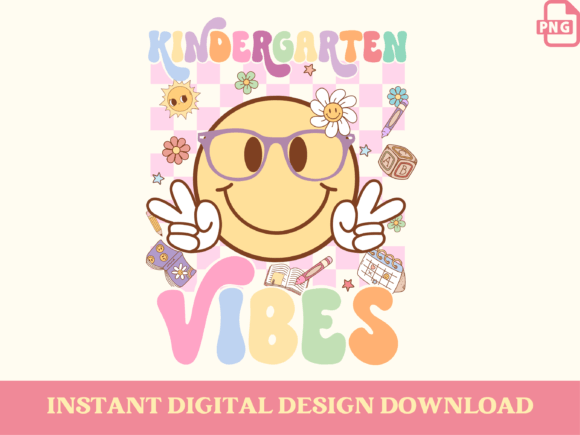
In kindergarten settings, every visual cue communicates something—even unconsciously. Bright but balanced color palettes, soft edges, friendly proportions, and playful yet legible typography all contribute to an environment where young learners feel safe, seen, and invited to explore. The Kindergarten Vibes Back to School Design reflects this understanding through its “cute, groovy” sensibility—not childish, not overly trendy, but warmly contemporary. Think rounded sans-serif lettering paired with hand-drawn suns, smiling apples, or abstract chalkboard textures. These aren’t generic clipart elements; they’re curated motifs that echo the tactile, sensory-rich world of early learning.
This attention to emotional resonance extends beyond aesthetics. When teachers wear matching shirts featuring this design—or when school teams display coordinated banners, tote bags, or welcome signs—the visual consistency becomes a subtle anchor. It signals unity without uniformity, joy without oversimplification, and professionalism rooted in care rather than rigidity. In practice, schools using such cohesive visuals report stronger parent engagement during orientation events and smoother transitions for incoming students—evidence that thoughtful design functions as relational infrastructure.
Practical Flexibility Across Real-World Use Cases
The strength of the Kindergarten Vibes Back to School Design lies less in its charm and more in its adaptability. Unlike static printables or single-use templates, this digital resource is engineered for repeated, context-sensitive application. Its core features—PNG format with transparent background, high-resolution 300 DPI output, and multiple stylistic versions—unlock real-world utility across diverse workflows.
- Team apparel coordination: Whether ordering custom tees for a grade-level team, hoodies for a school-wide staff day, or aprons for classroom volunteers, the transparent-background PNG integrates cleanly into garment mockup tools. Designers can scale it precisely for chest pockets or full-back prints without pixelation—even on textured fabrics like organic cotton or linen blends.
- Classroom environment building: Teachers use the solid version for laminated name tags, center rotation cards, or behavior charts where clarity matters most. The distress version—featuring gentle texture overlays and subtle edge wear—adds tactile authenticity to bulletin board borders, reading nook signage, or student-made “welcome to our room” posters.
- Gift creation with meaning: For end-of-year appreciation, mentorship milestones, or even substitute teacher welcome kits, the design transforms ordinary items—mugs, tote bags, canvas journals—into personalized tokens. Because the files are reusable, a PTA member might create five distinct gifts from one purchase, adjusting colors or layout per recipient without licensing friction.
- Digital communication enhancement: Email headers, virtual meeting backgrounds, and newsletter banners benefit from the clean vector-ready quality. The absence of background allows seamless layering over photos of student artwork or classroom spaces—keeping focus on people, not graphics.
Design Integrity Meets Technical Readiness
Many educators encounter beautifully illustrated designs only to discover limitations upon download: low resolution, embedded watermarks, or opaque backgrounds that resist editing. The Kindergarten Vibes Back to School Design avoids these pitfalls by design. Its 300 DPI resolution ensures fidelity whether printed at 2” x 2” for badge reels or scaled to 48” wide for hallway banners. The inclusion of both solid and distress variants isn’t decorative—it’s functional foresight. A solid version guarantees readability at distance or small scale; the distress variant adds depth and warmth for close-up applications where texture enhances approachability.
Crucially, the transparent-background PNG format supports non-destructive editing in free and paid tools alike—from Canva and Google Slides to Adobe Illustrator and Affinity Designer. Educators don’t need advanced graphic skills to adjust size, recolor elements (using layer blending modes), or combine the design with student-drawn elements. This lowers the barrier to authentic, locally relevant implementation—something increasingly valued in districts prioritizing culturally responsive practices.
Who Benefits—and How They Use It Differently
While teachers are central users, the Kindergarten Vibes Back to School Design serves a broader ecosystem of professionals invested in early learning environments:
- School administrators integrate it into onboarding kits for new hires—pairing the design with orientation schedules and classroom supply lists to reinforce culture from day one.
- PTA/Booster club organizers use it to unify fundraising materials: consistent branding across bake sale banners, auction item tags, and volunteer sign-up sheets builds trust and recognition.
- Educational content creators embed it into printable resources—lesson plan covers, editable parent letters, or interactive PDFs—enhancing perceived credibility and user engagement.
- Small business owners (e.g., boutique stationery shops or local screen printers) license or resell derivative products—knowing the source files support professional production standards and allow for color customization aligned with client brand guidelines.
- Student teachers and interns apply it to reflective portfolios or presentation decks, visually anchoring their work in the ethos of nurturing, developmentally appropriate practice.
Long-Term Value Beyond the Back-to-School Window
One of the most underappreciated advantages of this resource is its longevity. Because the files are downloadable and reusable without time limits or usage caps, the Kindergarten Vibes Back to School Design evolves alongside its owner’s practice. A teacher might use the solid version for first-day t-shirts in August, repurpose the distress variant for fall harvest festival signage in October, and later invert the colors for a winter-themed classroom door display—all without additional cost or permission hurdles.
This reusability also supports sustainability goals. Institutions reducing single-use paper materials can rely on durable, multi-purpose digital assets instead of reprinting seasonal decor annually. Likewise, individual educators avoid accumulating physical storage for outdated printables—opting instead for cloud-based access to a compact, versatile toolkit.
Aligning With Educational Values—Not Just Trends
What separates this design from algorithm-driven “teacher aesthetic” trends is its grounding in pedagogical intention. Groovy doesn’t mean chaotic; cute doesn’t mean condescending. The curves are generous but not saccharine, the palette leans toward earthy corals and muted sage rather than neon overload, and the spacing invites breathing room—mirroring best practices in visual processing for developing readers and neurodiverse learners.
Research in environmental psychology underscores how consistent, warm visual cues reduce cognitive load and increase feelings of belonging—especially for children entering unfamiliar spaces. When a child sees the same gentle sun motif on their name tag, the classroom door, and the teacher’s lanyard, it creates continuity. That continuity isn’t accidental. It’s designed.
Getting Started Without Overcomplication
Implementation requires no specialized software or training. After download, users can immediately:
- Drag the PNG into Canva, resize to fit any template (tote bag, mug, poster), and export for printing;
- Upload to a local print shop’s portal—most accept PNGs directly and auto-detect transparency;
- Insert into Google Slides or PowerPoint to build editable classroom displays;
- Layer over student photos in free apps like Photopea for personalized welcome videos;
- Use the distress version as an overlay in video editing tools (e.g., CapCut) to add analog warmth to digital announcements.
No subscriptions. No attribution requirements. No hidden fees for commercial reuse within personal or institutional educational contexts. Just clarity, consistency, and creative autonomy—delivered in a format that respects both the educator’s time and the learner’s experience.
A Design That Grows With You
Ultimately, the Kindergarten Vibes Back to School Design functions as more than a seasonal asset. It’s a reflection of how far educational design has come—from clipart-heavy worksheets to intentional, human-centered visual systems. Its value isn’t locked into August—it lives in the shared smiles during morning meetings, the confidence of a new teacher wearing her first team shirt, the quiet pride in a classroom wall that feels unmistakably *theirs*. In a profession where so much is measured, managed, and mandated, having one element that’s joyful, flexible, and entirely yours remains deeply meaningful.