Back to School Writing Pencil Cliparts: A Practical Guide for Educators and Designers
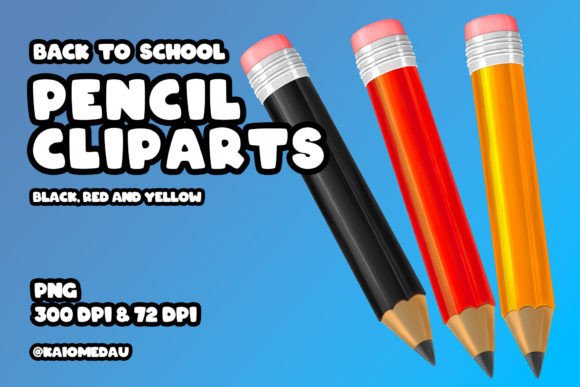
Back to School Writing Pencil Cliparts refer to a curated set of hand-drawn, transparent-background illustrations featuring classic yellow, red, and black pencils—each rendered in two resolutions (300 DPI for print and 72 DPI for digital use). Unlike generic vector icons or AI-generated doodles, this collection emphasizes tactile, analog charm: visible pencil grain, subtle shading, and intentional imperfections that evoke the quiet focus of handwriting. It’s not just clipart—it’s a stylistic anchor for projects where warmth, authenticity, and educational resonance matter.
What Sets These Pencil Illustrations Apart
Most school-themed graphics fall into one of three categories: minimalist line art (clean but emotionally neutral), cartoonish vectors (playful but potentially age-restricted), or photorealistic assets (versatile but visually heavy). Back to School Writing Pencil Cliparts occupies a middle ground—hand-crafted yet scalable, nostalgic yet functional. The consistent 300/72 DPI dual-resolution setup means you’re not forced to resample or compromise quality across contexts. And because each file uses a true alpha channel—not a white or colored background—layering into lesson plans, slide decks, or printed handouts requires no extra editing time.
The color palette is intentionally restrained: yellow (the iconic #2 pencil), red (for emphasis or correction), and black (for contrast and sophistication). This avoids visual clutter while supporting accessibility—unlike rainbow-colored sets that can overwhelm students with sensory sensitivities or dilute design hierarchy.
How They Compare With Common Alternatives
When evaluating options, consider your primary use case and workflow constraints:
- Free online clipart libraries often offer pencil-themed images—but many lack transparency, have inconsistent sizing, or embed watermarks. Others use low-resolution JPEGs that pixelate when enlarged. Back to School Writing Pencil Cliparts eliminates those variables with ready-to-use PNGs, clearly labeled by resolution and color.
- Subscription-based design platforms (e.g., Canva Elements or Adobe Stock) provide broader variety but require ongoing fees and may limit commercial reuse. These cliparts are a one-time acquisition with clear licensing for classroom and small-business applications—ideal if you need reliability without recurring cost or platform dependency.
- Custom illustration services deliver full uniqueness but involve lead time, budget (often $150–$500+ per asset), and revision cycles. Back to School Writing Pencil Cliparts offers professional-grade execution at a fraction of the effort and expense—especially useful when launching multiple back-to-school materials on a tight timeline.
Vector formats (like SVG or EPS) offer infinite scalability but demand design software proficiency to edit stroke weight, color, or texture. PNGs, by contrast, work instantly in PowerPoint, Google Slides, Word, Canva, and even basic photo editors—making them more accessible for teachers who aren’t designers.
Real-World Use Cases and Practical Fit
These illustrations shine where intentionality meets efficiency. For example:
- A third-grade teacher creating a “Writing Workshop” bulletin board might layer the yellow pencil over handmade paper textures and pair it with student-drawn story prompts—its soft edges blend naturally, unlike sharp-edged vectors that look digitally imposed.
- An instructional coach developing printable reflection sheets could place the red pencil beside editable text fields for peer feedback, using its color psychology to signal review without adding text instructions.
- A small tutoring business designing welcome cards for new families might combine the black pencil with serif typography and muted tones—conveying professionalism and academic grounding without feeling sterile.
They also integrate well into hybrid environments: the 72 DPI files display crisply on interactive whiteboards and LMS dashboards, while the 300 DPI versions hold up in laminated anchor charts or parent newsletter printouts. That dual-resolution consistency is rare in affordable clipart bundles—and eliminates guesswork about which file to choose for which output.
Limitations and When to Look Elsewhere
No single resource fits every need. Back to School Writing Pencil Cliparts excels in focused, warm, analog-aligned design—but has boundaries worth acknowledging.
It does not include variations like pencils with erasers, mechanical pencils, or pencils held in hands—so if your project requires action-oriented or inclusive representation (e.g., showing diverse grips or adaptive tools), you’ll need supplemental assets. It also doesn’t offer editable layers (e.g., separate pencil body and graphite tip), so fine-tuning individual components isn’t possible without raster editing skills.
If your work leans heavily toward modern, tech-forward branding—think coding camps, STEM fairs, or digital literacy programs—these illustrations may feel too traditional. In those cases, geometric line art or isometric pencil icons might better match your visual language.
Likewise, if you need large-scale murals, fabric prints, or animated social media assets, scalable vectors or motion-ready formats would be more appropriate. PNGs, while high-quality, have fixed dimensions—meaning extreme enlargement beyond their native size risks softness, even at 300 DPI.
Making an Informed Choice
Ask yourself these questions before selecting Back to School Writing Pencil Cliparts—or any similar resource:
- What’s your primary output medium? If you regularly produce both printed materials and digital slides or web content, the included dual-resolution PNGs reduce conversion steps.
- How much design flexibility do you actually need? If you rarely adjust colors or isolate parts of an image, hand-crafted PNGs save time over editable vectors that require learning curves.
- Does tone matter as much as utility? If conveying approachability, tradition, or quiet confidence aligns with your teaching philosophy or brand voice, these illustrations support that message more cohesively than generic alternatives.
- What’s your tolerance for licensing ambiguity? Reputable clipart sets clarify usage rights upfront—including whether you can use them in paid resources, merchandise, or district-wide templates. Verify scope before assuming permissions.
Back to School Writing Pencil Cliparts is strongest when used deliberately—not as filler, but as a unifying visual motif. Its value isn’t in quantity or flashiness, but in consistency, clarity, and contextual fit. That makes it especially useful for educators building cohesive classroom ecosystems, curriculum developers standardizing resource aesthetics, or small businesses crafting memorable, human-centered school-year messaging.
Ultimately, the right clipart choice depends less on technical specs alone and more on how well an asset supports your goals—without demanding disproportionate time, training, or budget. Back to School Writing Pencil Cliparts meets that bar for a specific, meaningful slice of back-to-school design work: grounded, adaptable, and quietly thoughtful.