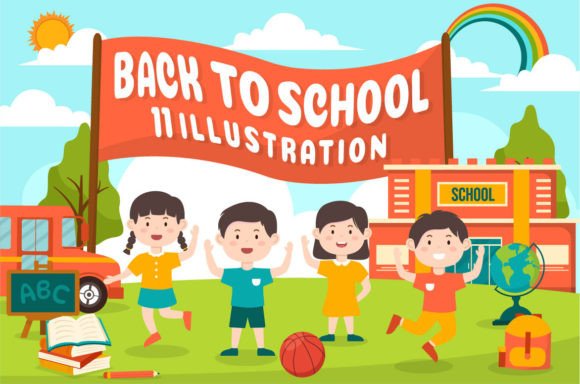
Back to School Vector Illustration 50
Whether you're launching a summer learning program, updating your tutoring business website, or designing back-to-school social media campaigns for an education nonprofit, Back to School Vector Illustration 50 offers a practical, time-saving solution—not just another clipart pack. It’s a curated set of 100 scalable, editable vector illustrations built around the visual language of learning: notebooks, pencils, globes, chalkboards, backpacks, graduation caps, and classroom icons—all in clean flat design style.
What makes this collection especially useful isn’t just quantity—it’s how each illustration is constructed. Every element is fully layered and grouped logically in Adobe Illustrator. That means you’re not stuck with a flattened image. You can isolate a single pencil tip, recolor a notebook’s spiral binding independently from its cover, or scale a chalkboard icon to billboard size without pixelation—then adjust stroke weight or spacing to match your brand guidelines.
Design Flexibility That Fits Real Workflows
Freelance designers and small marketing teams often juggle tight deadlines across multiple platforms. With Back to School Vector Illustration 50, you avoid the friction of hunting for consistent assets across stock sites—or worse, redrawing similar elements from scratch. Need a banner for a school supply sale? Pull a backpack icon, swap its color to match your store’s palette, add a “20% OFF” badge using the same font hierarchy already used in your brand kit, and export in seconds. Want a custom infographic showing student progress milestones? Combine the calendar, checkmark, and trophy icons—then rearrange and resize them proportionally without distortion.
This level of modularity supports iterative work. Educators building online course landing pages can test different visual hierarchies: maybe placing a graduation cap above a headline one week, then shifting it beside a testimonial quote the next—all without waiting for a designer or re-exporting new files.
Where Customization Saves Time (and Reduces Decision Fatigue)
Many users assume “editable vectors” mean “I’ll spend hours tweaking.” Not here. Each illustration in Back to School Vector Illustration 50 uses intuitive layer naming and non-destructive grouping. Colors are applied via swatches—not hardcoded fills—so changing an entire palette takes three clicks: select all, open the Swatches panel, and apply a new global color. No hunting through nested layers or manually adjusting gradients.
This matters most when consistency across channels is critical. A university communications team might use the same blue for their email headers, Instagram stories, and printed orientation brochures. With these vectors, that blue applies uniformly—even if one asset appears at 800px wide on a mobile ad and 4000px tall on a campus banner.
Real-World Use Cases Across Roles
- Small business owners running after-school programs can build cohesive seasonal promotions—using the same illustrated book stack across Facebook posts, Canva flyers, and printed handouts—without licensing concerns or resolution limits.
- Educational bloggers benefit from having ready-made, on-brand visuals for posts about study tips or classroom tech tools. Instead of generic stock photos, they insert a stylized laptop + notebook combo that reflects their voice—friendly but focused.
- Instructional designers developing LMS modules use the vector icons to label navigation tabs (“Assignments”, “Grades”, “Resources”) with clarity and visual continuity—reducing cognitive load for learners.
- Nonprofit fundraisers create compelling campaign assets fast: overlay a transparent “Donate Now” button on a high-res JPG version of the classroom scene, then reuse the EPS file to adapt the same layout for donor thank-you emails.
Technical Fit: What Works—and When to Pause
The collection delivers both EPS (for full vector editing) and JPG (5000 × 5000 px, ideal for print or large-format digital displays). That dual format covers most common needs—but keep context in mind. If you’re working exclusively in Figma or Sketch and don’t have Illustrator access, you’ll need to convert EPS files first (which may flatten some layer relationships). Similarly, while the flat design style ensures broad compatibility, it may not suit brands requiring photorealistic or hand-drawn textures. In those cases, consider whether blending these vectors with custom illustrations—or pairing them with complementary photo assets—better serves your message.
Also note: Though every shape is individually editable, the collection doesn’t include animated variants or interactive states (e.g., hover effects for web buttons). Those require additional development work—but the clean vector foundation makes exporting SVGs for such enhancements straightforward.
Why “Countless Variations” Isn’t Marketing Speak
You can truly mix and match. Take the “student at desk” scene: detach the desk, replace the chair with a standing desk icon from another illustration, add a speech bubble from the “teacher feedback” set, and recolor the student’s shirt to align with your diversity-in-education initiative. Because all 100 illustrations share the same grid alignment, stroke weights, and visual rhythm, combinations feel intentional—not collaged.
This interoperability extends beyond aesthetics. Publishers creating children’s activity books use the alphabet icons alongside the crayon and ruler sets to build themed puzzles. Edtech startups building dashboards use the progress bar, medal, and clock icons together to visualize learning streaks—each retaining its own editable properties while functioning as part of a unified system.
A Resource That Grows With Your Needs
Unlike single-use graphics, Back to School Vector Illustration 50 scales with your projects—not just in size, but in scope. One user repurposed the “library card” icon into a loyalty program badge; another turned the “lightbulb + book” combo into a webinar series logo. The value multiplies when you treat the set not as static images, but as a flexible visual vocabulary.
That said, it’s not a replacement for strategic visual identity work. If your brand relies heavily on custom illustration or narrative-driven scenes, these vectors serve best as supporting elements—not sole storytelling devices. Think of them as reliable, well-crafted tools in your kit: precise when you need consistency, adaptable when you need variation, and always ready to help you communicate clearly—without slowing you down.