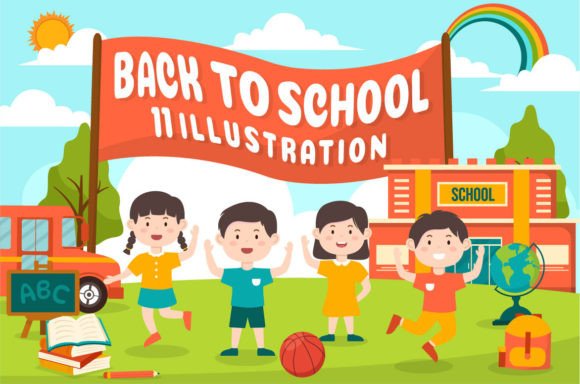
Back to School Vector Illustration 44: A Practical Asset for Branding, Education, and Digital Communication
Back to School Vector Illustration 44 is a curated set of 100 high-resolution, flat-design vector illustrations tailored for professionals who need visual flexibility without sacrificing quality or efficiency. Unlike generic clipart or raster-based assets, this collection delivers consistent style, precise scalability, and full editability—making it especially useful for time-sensitive projects where customization matters more than decoration.
What Sets This Collection Apart
At its core, Back to School Vector Illustration 44 offers more than thematic relevance—it provides structural utility. Each illustration is built in Adobe Illustrator using clean paths, organized layers, and non-destructive grouping. That means every shape—whether a notebook icon, chalkboard texture, pencil silhouette, or classroom layout—can be individually selected, recolored, resized, rotated, or deleted without affecting surrounding elements. There’s no embedded raster content, no locked layers, and no hidden clipping masks that complicate editing.
The inclusion of both EPS (for vector fidelity) and JPG (5000 × 5000 px) files adds practical versatility. Designers working in Illustrator can refine shapes and typography directly; marketers preparing social media posts can drop in crisp raster versions without worrying about rendering issues on mobile feeds; educators building printable handouts get pixel-perfect clarity at any print size.
Real-World Usability Across Roles
Freelancers and small business owners often juggle multiple clients with varying brand guidelines. Back to School Vector Illustration 44 supports rapid adaptation: swap a blue backpack for orange to match a client’s palette, adjust stroke weight for web vs. large-format banner use, or isolate a single desk icon to build a custom infographic about learning environments. One user reported assembling a full landing page mockup—including hero banner, feature icons, and testimonial dividers—in under two hours by combining and re-styling just seven illustrations from the set.
Educators and training coordinators benefit from the collection’s conceptual range. Rather than sourcing disparate icons from multiple libraries—each with inconsistent line weights or proportions—this set maintains visual harmony across themes like remote learning, classroom collaboration, student engagement, and academic milestones. A university communications team used 12 illustrations from Back to School Vector Illustration 44 to unify their fall semester campaign across email newsletters, digital signage, and printed orientation guides—all while keeping color schemes aligned with institutional branding.
Bloggers and content creators focused on education technology, parenting resources, or curriculum design find value in the set’s narrative potential. Because elements are modular—not just isolated icons—you can combine a laptop, graduation cap, and open book to visualize “online degree pathways,” or layer a speech bubble over a group of students to represent inclusive discussion. This compositional flexibility reduces reliance on stock photography, which often lacks authenticity or cultural specificity.
Quality and Consistency in Practice
Flat design doesn’t automatically mean low effort or shallow impact. The strength of Back to School Vector Illustration 44 lies in its disciplined execution: uniform stroke widths (where applicable), balanced negative space, intentional simplification—not oversimplification—and thoughtful alignment of visual hierarchy. Elements avoid visual noise: no unnecessary gradients, shadows, or textures that degrade when scaled down for mobile thumbnails or enlarged for trade show banners.
That said, consistency comes with constraints. Because all illustrations adhere to the same stylistic language—clean lines, minimal detail, and purposeful abstraction—they’re less suited for projects requiring photorealism, hand-drawn charm, or maximalist illustration. If your brand voice leans heavily into watercolor textures or sketch-style line work, this set won’t bridge that gap. It excels within its lane: functional, scalable, brand-agnostic vector graphics that serve communication goals first.
Workflow Integration and Technical Reliability
Compatibility with Adobe Illustrator is straightforward—no conversion steps, no font substitution warnings, no missing links. All text elements are outlined, and color swatches follow standard CMYK/RGB conventions. Users report seamless integration into existing design systems: global color palettes update across illustrations with one click; artboards export cleanly to PDF or SVG for web developers; and layer naming conventions (e.g., “Background_Shape,” “Icon_Main”) reduce onboarding time for team collaborators.
Resizing behaves predictably. Whether scaling a single icon to 24 px for an app interface or expanding a full scene to 36 inches wide for a conference backdrop, edges remain sharp, curves stay smooth, and proportions hold. This reliability eliminates guesswork during production handoffs—especially valuable when designers pass assets to developers or printers unfamiliar with vector nuances.
Who Benefits Most—and When
Back to School Vector Illustration 44 serves professionals whose work intersects education, marketing, or digital content creation—but only when their needs align with its technical and aesthetic profile. Ideal users include:
- Marketing managers launching seasonal campaigns for tutoring services, edtech platforms, or school supply retailers;
- Instructional designers building interactive e-learning modules where consistent iconography improves usability;
- Small business owners creating branded merchandise (stickers, tote bags, notebooks) without hiring a custom illustrator;
- Bloggers and newsletter publishers illustrating recurring topics like study tips, back-to-school checklists, or teacher wellness;
- Nonprofit communicators developing accessible, multilingual outreach materials where clear, symbolic imagery outperforms complex visuals.
It’s less optimal for illustrators seeking source material for derivative artwork (the licensing terms restrict resale or redistribution of modified versions), or for agencies building highly distinctive brand worlds where custom illustration is a strategic differentiator.
Practical Recommendations for Getting Started
Start small. Open one EPS file in Illustrator, ungroup the elements, and experiment with the Recolor Artwork tool to preview how the illustration adapts to your brand palette. Try exporting a single element as SVG and embedding it directly into a webpage to test responsiveness. If you're building infographics, use the Align panel to distribute related icons evenly—most illustrations include invisible bounding boxes that snap predictably.
When combining elements across files, watch for overlapping anchor points or stray points that may cause rendering glitches in certain browsers or PDF viewers. A quick “Object > Path > Clean Up” in Illustrator resolves most of these before export. And if you're preparing files for print, double-check that all colors are set to CMYK and that black text uses 100% K only—not rich black—unless intentional.
Finally, treat the set as a foundation—not a finish. Its real value emerges not in using illustrations as-is, but in adapting them deliberately: cropping to emphasize action, layering transparency for depth, or pairing with original photography to add human context. One educator layered a transparent chalkboard illustration over a photo of her actual classroom wall, then added student-drawn quotes in editable text boxes—creating a hybrid asset that felt personal yet professionally polished.
Back to School Vector Illustration 44 won’t replace strategic visual thinking—but it does remove friction from execution. For professionals balancing tight deadlines, limited design resources, and the need for visual coherence, it’s a pragmatic tool worth evaluating on its ability to support clarity, consistency, and speed—not just aesthetics.