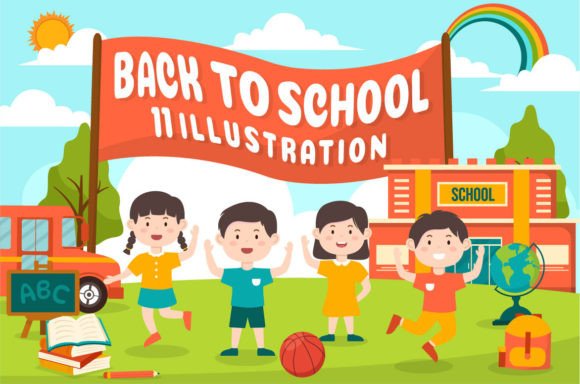
Back to School Vector Illustration 36
If you're designing a back-to-school campaign—whether for a tutoring service, educational app, school newsletter, or classroom resource—you need visuals that communicate energy, clarity, and approachability. Back to School Vector Illustration 36 delivers exactly that: a versatile, editable, flat-design vector set built for real-world use—not just decoration.
This isn’t a single static image. It’s one of 100 high-resolution vector illustrations included in a cohesive collection, all designed with consistency in mind. Each illustration is delivered in EPS (fully editable in Adobe Illustrator) and JPG (5000 × 5000 px), so you get both flexibility and pixel-perfect output—no guessing whether your banner will blur at full width or whether your social post will look muddy on mobile.
What People Often Misunderstand About Back to School Vector Illustration 36
Many assume “vector” automatically means “easy to customize”—but that’s only true if the file is well-structured. Some free or low-cost packs use grouped objects, embedded raster layers, or locked clipping masks that prevent simple color swaps or shape adjustments. With Back to School Vector Illustration 36, every element—including chalkboards, notebooks, pencils, backpacks, and even subtle background textures—is fully separated and ungrouped by default. That means you can change the color of a pencil tip without affecting the eraser, recolor a notebook cover independently from its pages, or delete an element entirely without breaking the composition.
Another common oversight? Assuming resolution guarantees quality. A 5000 × 5000 JPG looks sharp on screen—but if the underlying vector wasn’t built with clean anchor points and consistent stroke weights, scaling it down for a favicon or up for a trade show banner introduces jagged edges or uneven spacing. These illustrations were crafted with precision: aligned grids, uniform corner radii, and optimized paths—so resizing truly works, both up and down.
Why “Easy to Edit” Isn’t Just Marketing Language
You’ll see “easy to edit” everywhere—but what does it actually mean in practice? For Back to School Vector Illustration 36, it means:
- No hidden layers: What you see in the Layers panel is exactly what’s editable—no buried assets or password-protected groups.
- Named layers and subgroups: “Desk,” “Student,” “Books,” “Icons”—not “Layer 1 copy 2a.” This saves time when you’re adjusting dozens of assets across multiple projects.
- Global swatches pre-loaded: Colors are assigned via swatches—not hardcoded fills—so changing your brand palette takes seconds, not hours.
- No fonts embedded as outlines (unless intentional): Text elements like “First Day!” or “Study Smart” remain live-editable, letting you update messaging without redesigning.
Compare that to a pack where every icon is flattened into a compound path, or where colors are applied with 17 different shades of blue—all manually selected. You’d spend more time reverse-engineering than designing.
Avoiding the “Mix-and-Match Trap”
Yes, you can combine elements from different illustrations in the set—and that’s powerful. But doing it haphazardly leads to visual inconsistency. One backpack might use sharp corners while another uses soft curves; one notebook may have thick line weight and another thin. When stitched together without attention, the result feels disjointed—not custom-built.
The smarter approach? Use the built-in style guide (included in the download folder). It documents line weights, spacing rules, corner radius values, and primary/secondary color palettes used across all 100 illustrations. Reference it before swapping elements—and test combinations at actual size. A backpack + laptop combo may look balanced at thumbnail size but overwhelm a landing page hero section. Preview in context, not just in Illustrator.
What to Check Before You Download or Purchase
Before adding Back to School Vector Illustration 36 to your workflow, ask yourself three practical questions:
- Do I need scalability *and* pixel fidelity? If your use case includes print (brochures, posters) *and* digital (email headers, Instagram carousels), vector + high-res JPG covers both. PNG-only packs fall short for large-format printing.
- Will I adjust colors frequently? If your brand updates seasonally—or if you serve multiple clients with different palettes—swatch-based editing (not manual fill changes) saves hours per project.
- Is consistency across touchpoints important? Educators sending weekly newsletters, marketers running multi-channel campaigns, or freelancers building client brands all benefit from unified visual language. This set was built to scale across platforms—not just look good in isolation.
Also verify file compatibility. While EPS works in Illustrator, Affinity Designer, and CorelDRAW, some older versions require CS6 or newer. If you use Inkscape or Figma, open the EPS first to confirm no elements shift or disappear—some converters misread legacy Illustrator effects.
Real Use Cases—Beyond the Obvious
Most people reach for back-to-school vectors for August promotions. But their utility extends further:
- Educators: Turn a single illustration into a printable classroom reward chart—swap icons, add student names, export as PDF for laminating.
- EdTech startups: Use layered vectors to build animated onboarding sequences—animate the pencil drawing a checkmark, or have books slide in one by one.
- Freelance designers: Combine desk + laptop + speech bubble to create custom testimonial graphics—no stock photo licensing headaches.
- Small business owners: Resize the same illustration for a Facebook cover (820 × 312 px), email header (600 × 200 px), and printed flyer (8.5 × 11 in @300 dpi)—all from one source file.
And because each of the 100 illustrations shares the same design DNA, mixing assets feels intentional—not like patchwork.
Final Thought: Design Time Is Real Time
Every minute spent wrestling with unorganized layers, mismatched proportions, or non-scalable files is a minute taken from strategy, writing, or user testing. Back to School Vector Illustration 36 doesn’t promise magic—it promises efficiency grounded in thoughtful construction. It respects your time, your tools, and your audience’s expectations for polish and clarity.
Happy designing. Happy purchasing.