Back to School Colorful Background: A Practical Asset for Educators and Creators
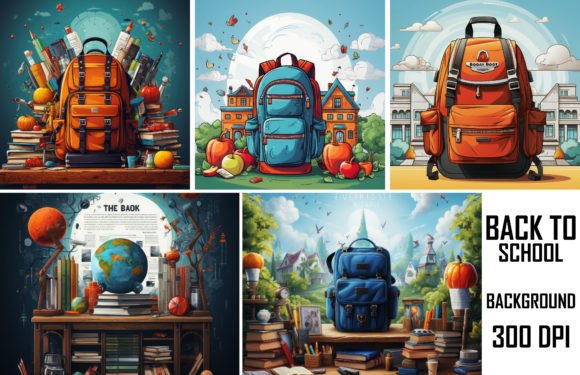
A well-designed Back to School Colorful Background serves more than decorative purposes—it supports communication, reinforces tone, and enhances visual consistency across digital and print materials. This particular set stands out not because it’s flashy or trend-driven, but because it balances versatility with functional simplicity. It consists of five high-resolution PNG files, each built from 100 vector-based shapes, making them fully scalable without quality loss. The collection is delivered in a single ZIP file—standard practice for digital asset distribution—and can be extracted using common tools like WinRAR, WinZIP, or even the native extraction features built into modern operating systems.
What Makes This Back to School Colorful Background Distinctive?
Unlike many themed background packs that rely on raster-only layers or fixed dimensions, this set leverages vector-derived elements embedded within PNGs. That means each file retains crisp edges at any size—from social media banners (1200×630 px) to classroom posters (24×36 inches)—without pixelation or manual reworking. The “colorful” aspect isn’t arbitrary: hues are carefully selected for accessibility and contrast, avoiding oversaturation while maintaining energy and approachability. You’ll find combinations of teal, coral, mustard, lavender, and sky blue—colors that work equally well for elementary announcements and professional development slides.
The inclusion of 100 vector shapes per file adds tangible editing flexibility. These aren’t just clipart overlays; they’re modular components—arrows, stars, books, pencils, speech bubbles, geometric frames—that can be individually recolored, resized, or repositioned in compatible editors (Adobe Illustrator, Affinity Designer, or even Figma with proper import settings). Because they originate from vectors, adjustments don’t degrade fidelity—even after multiple iterations.
Real-World Usability Across Workflows
In practice, users report integrating this Back to School Colorful Background into three primary categories of output:
- Educational communications: Teachers use one background as a consistent header across weekly newsletters, Google Classroom banners, and printed welcome packets. The predictability of layout helps students and families quickly recognize official messaging.
- Marketing and outreach: Tutoring centers, edtech startups, and homeschool co-ops apply these backgrounds to email headers, webinar slides, and Instagram story templates—maintaining brand-aligned visuals without custom design time.
- Content creation: Bloggers and course creators layer text over the PNGs for Pinterest pins or YouTube thumbnails, relying on built-in visual hierarchy (e.g., open space in the upper third) to ensure legibility.
One educator noted using the same background across a full August–September campaign—first as a Zoom virtual background, then scaled for a printable “All About Me” student handout, and finally repurposed (with shape removal) as a clean base for a parent survey form. That kind of reuse reflects thoughtful construction—not just aesthetic appeal.
Quality and Technical Reliability
All five PNGs are exported at 300 DPI and include transparent backgrounds where appropriate, supporting seamless layering in both design and publishing software. File sizes remain manageable (between 8–15 MB each), so they integrate smoothly into CMS platforms like WordPress or Canva without triggering upload limits. No fonts are embedded—text must be added separately—which preserves cross-platform compatibility and avoids licensing complications.
There’s no hidden scripting, no proprietary format lock-in, and no subscription requirement. Once downloaded and extracted, the assets belong to you outright. That permanence matters for schools with limited IT support or freelancers managing long-term client assets. Unlike cloud-based templates that may change or disappear, this Back to School Colorful Background remains stable, version-controlled, and locally accessible.
Who Benefits Most—and When?
This resource fits best for professionals who need dependable, editable visuals on short timelines—but aren’t designers by trade. Think:
- Classroom teachers preparing first-week materials without access to graphic design training or budget for custom illustrations;
- Small business owners running after-school programs or learning studios who manage their own marketing;
- Instructional designers building LMS modules and needing consistent, cheerful UI elements;
- Bloggers and newsletter writers covering education topics and seeking cohesive seasonal visuals;
- Nonprofit coordinators producing bilingual back-to-school guides where clarity and visual warmth directly impact engagement.
It’s less ideal for teams requiring strict brand alignment with precise Pantone matches or those needing animated variants (GIF/WebP). Also, while the vector shapes are editable, doing so requires basic familiarity with vector tools—those unfamiliar with path manipulation may prefer pre-styled versions instead.
Practical Integration Tips
To maximize value, consider these workflow practices:
- Start with purpose, not palette: Choose the background that best supports your message’s emphasis—e.g., select the version with central negative space if overlaying dense text; pick one with perimeter motifs for visual framing around photos.
- Test readability early: Overlay sample headlines at your intended font size and weight before finalizing. Some colorful arrangements reduce contrast with light text—adjusting opacity or adding subtle drop shadows often resolves this.
- Preserve original layers: When editing in Illustrator or Affinity, ungroup shapes and rename layers meaningfully (e.g., “Header_Star_Cluster”) to simplify future revisions.
- Archive extracted files thoughtfully: Store the ZIP alongside a README noting usage rights, version date, and source—especially useful when collaborating or revisiting projects months later.
One small business owner shared how she used two of the backgrounds to unify her summer camp registration flow: one as the website hero image, another—slightly desaturated—as the confirmation email background. Consistency across touchpoints increased perceived professionalism without increasing design overhead.
Long-Term Value Beyond the Season
While labeled “Back to School,” the underlying design language isn’t tied exclusively to August or September. The motifs avoid overt calendar references (no calendars, bells, or apples-as-logos), and color relationships hold up for welcome events, orientation sessions, staff onboarding, or even end-of-year celebrations—particularly when adjusted via hue/saturation sliders. Several users have adapted the shapes into standalone icons for internal dashboards or reused individual elements as bullet points in faculty training decks.
That adaptability extends its shelf life meaningfully. Rather than being discarded after Labor Day, this Back to School Colorful Background functions as a foundational toolkit—scalable, editable, and quietly resilient across changing needs and audiences.