Watercolor Back to School Safari Animals
Imagine walking into a classroom where learning feels like an expedition—where a cheerful lion carries a stack of storybooks, an elephant wears tiny glasses and holds a pencil, and a giraffe peers over a globe with quiet curiosity. That’s the magic of Watercolor Back to School Safari Animals: a thoughtfully crafted collection of hand-painted illustrations that bridges early childhood education with the wonder of the natural world. Designed for educators, curriculum designers, homeschooling parents, and creative professionals, these graphics aren’t just decorative—they’re functional tools that support engagement, emotional connection, and visual literacy from day one.
Many teachers and resource creators face real challenges at the start of the school year: how to make transitions smooth for young learners, how to build inclusive and joyful classroom environments, and how to develop materials that feel both academically grounded and emotionally resonant. Standard clipart often feels generic or overly cartoonish—lacking warmth, nuance, or pedagogical intention. Meanwhile, high-quality, education-aligned visuals can be time-consuming to source or create from scratch. That’s where Watercolor Back to School Safari Animals steps in—not as a shortcut, but as a thoughtful, ready-to-use solution rooted in aesthetic integrity and developmental awareness.
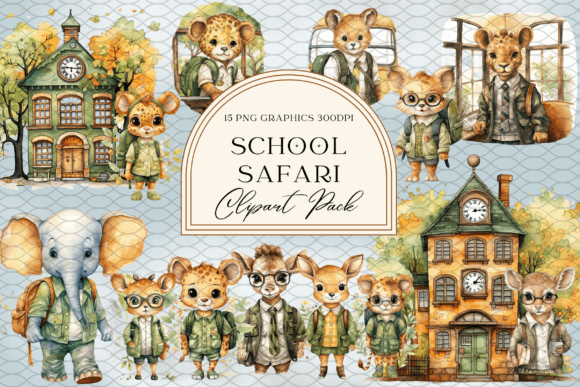
Each of the 15 individual elements is hand-painted using soft watercolor techniques, resulting in gentle gradients, subtle texture, and organic charm. The animals—lion, elephant, zebra, flamingo, monkey, rhino, cheetah, hippo, meerkat, parrot, turtle, owl, fox, panda, and kangaroo—are all rendered with expressive, approachable faces and playful back-to-school details: miniature backpacks, open notebooks, pencils tucked behind ears, and even tiny graduation caps. These aren’t anthropomorphized in a distracting way; instead, they model curiosity, readiness, and kindness—qualities we actively nurture in early learning settings.
The technical specs are designed for real-world use: high-resolution 300 dpi PNG files (5400×7200 px) ensure crisp printing on posters, banners, flashcards, and student handouts—even at large sizes. And because they’re delivered watermark-free, you retain full creative control: no attribution required, no licensing surprises, no pixelated compromises.
Here’s how educators and creators are putting Watercolor Back to School Safari Animals to work:
- Classroom decor that teaches: Print and laminate animal-themed name tags, behavior charts, or “All About Me” banners. A watercolor zebra holding a book beside a reading corner subtly reinforces literacy identity—without needing words.
- Customizable learning resources: Layer the graphics into editable slide decks, interactive PDFs, or digital storybooks. Pair a watercolor elephant with phonics prompts (“E is for Elephant!”) or math word problems (“The lion has 3 notebooks. He gets 2 more. How many now?”).
- Family engagement tools: Use the safari theme across welcome letters, supply lists, and virtual meet-the-teacher slides. Parents respond warmly to visuals that signal care, creativity, and intention—not just compliance.
- Homeschool planning & portfolios: Incorporate the graphics into weekly planners, achievement certificates, or nature-science unit studies. A watercolor meerkat peeking out from a “Habitats Around the World” poster invites deeper questioning and cross-curricular links.
Different users approach Watercolor Back to School Safari Animals with distinct priorities—and that’s by design. A kindergarten teacher might prioritize print-ready bulletin board kits and student-facing visuals that reduce cognitive load. A curriculum developer may focus on scalability: embedding the graphics into editable Canva templates or LMS-friendly modules. A small business owner creating educational printables might value commercial-use flexibility—knowing they can legally include these assets in paid products without additional fees or permissions.
Importantly, this collection supports inclusive practice. The soft watercolor style avoids rigid gender coding or cultural stereotyping. The animals’ expressions are warm but neutral—open to interpretation and personal connection. When students see themselves reflected not only in human characters but also in kind, capable animal peers, it quietly affirms belonging and agency.
Practical implementation starts with intentionality. Before downloading, consider your primary use case: Will these appear mostly in print? Digitally? Across multiple grade levels? For best results, pair the graphics with clear typography (e.g., rounded sans-serifs for younger grades, clean serifs for upper elementary), consistent color accents drawn from the watercolor palettes (think warm ochres, sage greens, dusty blues), and ample white space—letting the art breathe and guide attention.
Also worth noting: Because each element is delivered as a separate PNG file with transparent backgrounds, mixing and matching is effortless. You’re not locked into pre-set scenes—you can compose your own visual narratives. Place the watercolor flamingo beside a calendar chart, nestle the panda into a “Growth Mindset” poster, or float the cheetah across a “Fast Facts” science handout. This modularity saves hours of design time while preserving creative authenticity.
Finally, think beyond September. While Watercolor Back to School Safari Animals shines during orientation and the first weeks of school, its versatility extends across seasons and subjects. Repurpose the lion as a “Leadership Lion” for character education, the owl for “Wisdom Wednesday” reflections, or the turtle for slow-and-steady growth mindset lessons. In science units about habitats or adaptations, these same animals become familiar anchors—making abstract concepts tangible and memorable.
If you’ve ever spent hours searching for visuals that feel both joyful and intentional—if you’ve wished for classroom resources that honor children’s capacity for wonder *and* their need for structure—then Watercolor Back to School Safari Animals offers more than pretty pictures. It offers alignment: between aesthetics and pedagogy, between play and purpose, between the wild curiosity of childhood and the steady guidance of skilled teaching. It’s not just about going back to school—it’s about beginning again, together, with imagination as our compass.