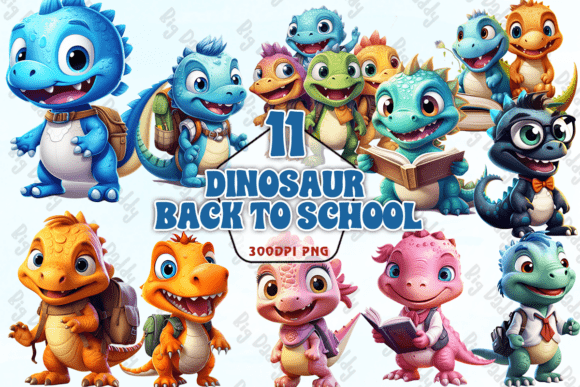
Dinosaur Back to School Sublimation
Sublimation design assets like Dinosaur Back to School Sublimation serve a specific, practical role in creative production workflows—especially for small business owners, educators, and craft-based entrepreneurs who regularly produce custom merchandise. They’re not standalone products; they’re precision tools embedded in a larger process of planning, personalization, and output. Understanding how and when to use them—before printing, during design iteration, or after client feedback—makes the difference between rushed execution and consistent, scalable results.
What This Asset Is—and What It’s Not
The Dinosaur Back to School Sublimation file you receive is a high-resolution PNG (4500 × 5400 pixels at 300 DPI), optimized for clarity across physical substrates. It’s not a pre-printed item, nor a ready-to-ship product—it’s a digital foundation. Its value lies in flexibility: color independence, vector-like scalability within raster limits, and transparency support. That means it integrates cleanly into layered design files without clipping or background interference.
This isn’t clipart for casual use. It’s built for sublimation—a heat-transfer process where ink bonds with polyester-coated or polymer-infused materials. That requires clean edges, high contrast, and intentional color separation—features this file delivers out of the box. If your workflow includes mug printing, tote bag customization, or classroom-themed apparel, this asset fits precisely where raw design input meets production readiness.
Where It Fits in Your Workflow
Think of Dinosaur Back to School Sublimation as a reusable component—not a one-off graphic. It enters your process at multiple points:
- Before production: You drop it into mockup templates (e.g., Spoonflower, Placeit, or Canva) to visualize final output on mugs, T-shirts, or notebooks. This step helps confirm sizing, color balance, and visual hierarchy before committing to print runs.
- During design refinement: Because it’s a transparent PNG at 300 DPI, you can layer it over gradients, textures, or typography without quality loss. Need to shift the palette to match school branding? Adjust hue/saturation non-destructively in Photoshop or Affinity Photo—no pixelation, no re-rendering.
- After delivery or feedback: A teacher requests matching stickers and bulletin board cutouts? Resize the same file down to 1500 × 1800 for vinyl cutting or up to 6000 × 7200 for framed wall art—both retain crisp detail thanks to its resolution headroom.
This kind of asset reduces version sprawl. Instead of juggling five differently sized or colored variants, you maintain one master file and adapt it per use case. That saves time, reduces storage clutter, and improves consistency across touchpoints—critical when building recognizable brand themes for back-to-school campaigns.
Compatibility and Setup Requirements
To use Dinosaur Back to School Sublimation effectively, your setup needs three things: a computer capable of unzipping archived files, a compatible design application, and awareness of format limitations.
You’ll need software that supports PNG transparency and high-DPI editing—Adobe Photoshop, GIMP, Affinity Designer, or even newer web-based tools like Photopea. Avoid basic photo editors (e.g., Windows Paint or Preview) that flatten layers or degrade resolution on resize. Also note: while the file is PNG, it’s not vector-based—so extreme enlargement beyond 200% may reveal subtle interpolation. For most standard sublimation applications (mugs, shirts, cards), that’s irrelevant. But if you’re scaling for large-format banners, pair it with a vector outline or use it as a base layer beneath scalable text elements.
File organization matters too. Store it in a clearly labeled folder (e.g., “Sublimation Assets / Education / Dino_BackToSchool”) alongside related resources—color palettes, font files, or print specifications. That way, when you revisit the project next August—or hand off to a contractor—you preserve context and reduce onboarding friction.
Practical Use Cases Across Roles
Educators and school staff use this asset to create cohesive classroom materials: printable name tags, laminated behavior charts, or themed reward certificates. Because it’s easy to recolor, you can align visuals with grade-level color coding (e.g., blue for Kindergarten, green for Grade 3) without sourcing new graphics.
Small business owners running Etsy shops or local craft fairs apply it across product lines—same core design on ceramic mugs, cotton-poly blend tees, and polyester pillow covers. Consistency builds recognition; efficiency keeps margins healthy. One file, multiple SKUs.
Freelance designers and marketers embed it into client deliverables—like editable Canva templates for PTA groups or school district social media kits. The high-res PNG ensures printed flyers hold up next to digital ads, reinforcing message continuity across channels.
Even bloggers and content creators repurpose it: convert sections into Instagram story highlights, extract icons for Pinterest infographics, or animate individual dino elements for YouTube intro sequences—all from the same source file.
Quality Control and Long-Term Usability
Because sublimation relies on precise color translation from screen to substrate, test prints matter. Always soft-proof using your printer’s ICC profile before bulk production. Check for unintended halos around dino outlines—these often appear when anti-aliasing interacts poorly with heat press settings. If needed, refine edges in your editor using the Refine Edge tool (Photoshop) or Select and Mask (Affinity), then re-export as PNG.
For long-term use, avoid saving over the original file. Instead, create dated copies (“Dino_BTS_2024_v2_ColorAdjusted”) or use version control via cloud folders with revision history (Google Drive, Dropbox). That preserves your starting point and documents iterations—valuable if you later expand the set with companion designs (e.g., “Dino Math Symbols” or “Dino Behavior Charts”).
Also consider accessibility: if distributing printable versions to schools, provide a simplified grayscale variant alongside the full-color file. Most design apps let you generate this in one click—just desaturate and adjust contrast to ensure legibility on low-ink printers.
Integrating Smoothly Into Your Routine
Start small. Pick one recurring task—say, creating weekly student incentive stickers—and replace your current graphic source with Dinosaur Back to School Sublimation. Time how long it takes to open, recolor, resize, and export. Compare that to your previous method. Chances are, the reduction in manual cleanup (no background removal, no resolution guessing) cuts minutes per batch.
Then scale: add it to your standard operating procedures. Include it in your onboarding checklist for new team members or contractors. Embed usage notes directly in your design template files (“Insert Dino_BTS here—scale to 85% for 11oz mugs”). The more embedded it becomes in repeatable actions, the less cognitive load it creates.
Finally, treat it as part of your asset library—not a disposable download. Audit it annually: does it still align with current branding? Are there gaps (e.g., missing bilingual labels or inclusive character variations)? Use those observations to guide future purchases or commission custom extensions.
That’s the real utility of Dinosaur Back to School Sublimation: not novelty, but reliability. It’s a quiet enabler—working behind the scenes so your focus stays on outcomes: engaged students, satisfied customers, timely deliveries, and work that scales without sacrificing quality.