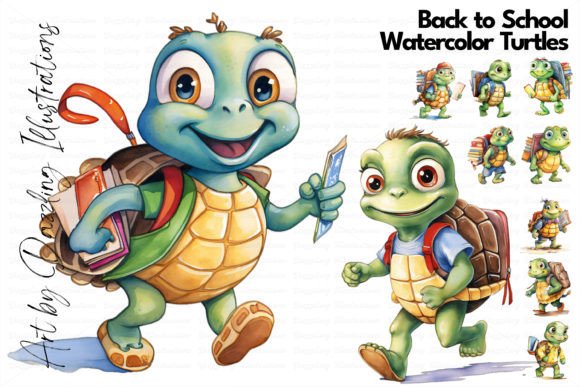
Back to School Watercolor Turtles
Thoughtful visual design isn’t just about aesthetics—it’s a strategic lever for clarity, connection, and credibility. The Back to School Watercolor Turtles clipart set is more than a collection of charming illustrations; it’s a purpose-built resource for professionals who understand that tone, warmth, and intentionality shape how messages land. These hand-painted turtles—each with a backpack, book, or notebook—carry quiet symbolism: patience, steady progress, and grounded curiosity. That resonance matters when you’re designing for learners, parents, educators, or customers who respond to authenticity over polish.
Why Visual Consistency Supports Strategic Goals
When launching back-to-school campaigns, classroom materials, or educational products, consistency in visual language reinforces trust and recognition. A single off-brand stock graphic can dilute messaging—even if it’s technically “on theme.” The Back to School Watercolor Turtles set avoids that risk by offering cohesive style, color harmony, and intentional detail across all 10 PNG files. Because they share the same watercolor texture, brushwork rhythm, and compositional balance, they integrate seamlessly into branded slide decks, printable worksheets, social media carousels, or email headers—without requiring extensive editing or color correction.
This isn’t convenience for convenience’s sake. It’s operational efficiency with downstream impact: fewer revision rounds, faster asset turnaround, and stronger alignment between your educational mission and the visuals that represent it.
Where Intentional Use Creates Real Value
The strategic value of the Back to School Watercolor Turtles emerges most clearly in three high-leverage contexts:
- Classroom & Curriculum Design: Teachers and curriculum developers use these illustrations to soften transitions (e.g., “Let’s begin our unit on habitats—meet Tilly the Turtle!”), label learning stations, or add visual scaffolding to instructions. Unlike generic clipart, these turtles invite narrative—making abstract routines feel relational and age-appropriate.
- Educational Product Positioning: Small business owners selling printables, lesson plans, or digital planners often struggle to differentiate in crowded marketplaces. Using the Back to School Watercolor Turtles as recurring visual anchors builds recognizable brand texture—especially when paired with consistent typography and layout discipline. That cohesion signals professionalism and care, which directly influences perceived value and willingness to pay.
- School Communication & Community Building: From welcome emails to PTA newsletters or event flyers, warm, human-centered visuals reduce cognitive load and increase engagement. A turtle holding a checklist beside “First-Day Prep Tips” lands differently than bullet points alone. It cues empathy, approachability, and shared experience—critical when addressing families navigating transitions.
Planning Your Implementation—Not Just Decoration
Before dropping a turtle into your next design, pause and ask: What outcome am I trying to support? If the goal is student engagement, consider pairing a turtle illustration with open-ended prompts (“What’s one thing you hope to carry in your backpack this year?”). If the goal is parent clarity, use the turtle as a visual anchor for key dates—its presence subtly reinforces continuity and calm amid logistical complexity.
Avoid treating the Back to School Watercolor Turtles as decorative filler. Instead, treat them like visual verbs—elements that do work. For example:
- Use the turtle with a clipboard to introduce assessment rubrics or self-reflection tools.
- Place the turtle holding a globe beside geography-themed vocabulary lists—not just because it’s “school-related,” but because it invites spatial thinking.
- Layer the transparent-background PNG over soft gradients or subtle textures to maintain depth without overwhelming text-heavy content.
Also consider scale and spacing. Watercolor elements breathe best with generous white space. Crowding them alongside dense fonts or competing icons weakens their effect—and risks making your design feel cluttered rather than curated.
Risks of Context-Free Usage
Even high-quality assets can undermine goals if applied without strategy. The main risks with the Back to School Watercolor Turtles aren’t technical—they’re contextual:
- Mismatched Tone: A whimsical watercolor turtle may feel incongruent in formal district-wide policy documents or compliance training. Ask whether warmth supports authority—or inadvertently softens urgency.
- Overuse Without Variation: Repeating the same turtle across every slide or handout breeds visual fatigue. Rotate between three or four distinct poses, or alternate with minimalist line art versions (if available) to sustain attention.
- Assuming Universality: While turtles evoke patience and resilience across many cultures, some educational settings prioritize different symbolic animals or avoid anthropomorphism entirely. When working cross-culturally or with diverse age groups, test reception before scaling usage.
These aren’t reasons to avoid the set—they’re reminders that intention precedes impact. Every visual choice either sharpens your message or blurs it. The Back to School Watercolor Turtles only amplify what’s already clear in your planning.
Long-Term Branding & Resource Efficiency
Think beyond August. The Back to School Watercolor Turtles have extended utility—not as seasonal decoration, but as adaptable visual infrastructure. With minor recoloring or layering, they can support growth mindset themes (“Carrying new skills forward”), environmental science units, or even mindfulness activities (“What helps you retreat and reflect, like a turtle?”). That flexibility means you’re not buying 10 images—you’re acquiring a scalable visual vocabulary.
From an operations standpoint, having a vetted, rights-cleared, consistently styled asset library reduces dependency on last-minute searches, licensing negotiations, or inconsistent freelance deliverables. That reliability compounds over time: less time spent sourcing, more time spent refining pedagogy, messaging, or user experience.
How to Decide If This Set Fits Your Needs
Ask yourself these questions before investing:
- Do my current visuals communicate warmth and approachability—or do they default to sterile templates or overly complex graphics?
- Am I repeatedly adapting or redrawing similar elements (e.g., school-themed animals) instead of building on a unified system?
- Do I serve audiences—like young learners, neurodiverse students, or time-pressed educators—who benefit from visual cues that simplify, reassure, or delight?
- Is there a gap between how I want my materials to feel (grounded, joyful, thoughtful) and how they currently read?
If two or more answers are “yes,” the Back to School Watercolor Turtles likely fill a functional need—not just an aesthetic one.
Final Thought: Design as Deliberate Practice
Using the Back to School Watercolor Turtles well isn’t about mastering software or chasing trends. It’s about recognizing that every visual element participates in a larger system of meaning-making. When a student sees a turtle with a backpack on their math worksheet, they’re not just looking at clipart—they’re receiving a quiet signal: This space holds your pace. Your growth matters. You belong here.
That kind of resonance doesn’t come from volume or variety. It comes from alignment—between image and intent, effort and outcome, creativity and clarity. The Back to School Watercolor Turtles give you a starting point rooted in craft and care. What you build from there depends on how thoughtfully you choose to use them.