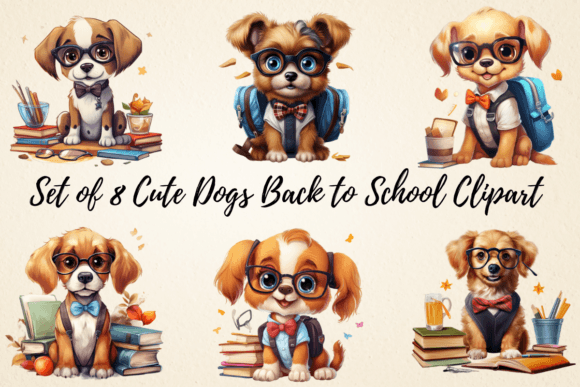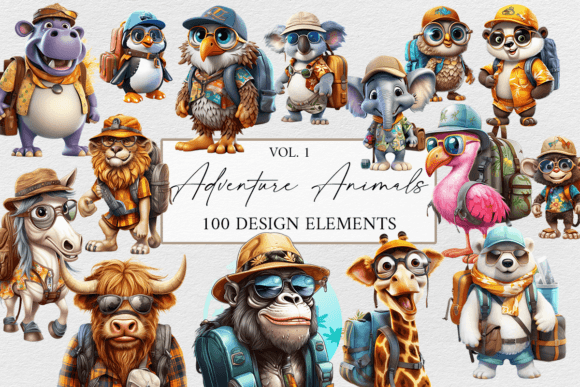
Back to School Animal Clipart Bundle
Imagine opening a digital folder and finding 100 cheerful, classroom-ready animal characters—each one drawn with warmth, personality, and quiet confidence. That’s the Back to School Animal Clipart Bundle: a thoughtfully curated set of high-resolution, transparent-background PNGs designed not just for cuteness, but for real creative work. These aren’t generic cartoon animals. They’re friendly foxes holding pencils, owls peering over notebooks, hedgehogs wearing tiny backpacks, and raccoons balancing stacks of books—all rendered in clean, confident line work and soft, school-appropriate color palettes. The style balances approachability with polish: expressive but never overwhelming, playful but never childish. It’s the kind of visual language that feels instantly familiar to educators and parents, yet fresh enough to stand out in a crowded marketplace.
Where These Animal Designs Earn Their Keep
This bundle shines where clarity, charm, and consistency matter most. Think classroom posters that hold up at arm’s length—and on a projector screen. Think printable behavior charts where each animal represents a different positive trait (e.g., “Squirrel = Ready to Learn,” “Turtle = Takes My Time”). Think sublimation mugs for teacher appreciation week, where crisp edges and smooth gradients translate cleanly onto ceramic surfaces. Or consider digital lesson plans shared via Google Slides: because every element is 300 DPI with full transparency, layering them into presentations or Canva templates is frictionless—no jagged edges, no background cleanup, no guesswork.
Small business owners use these assets in ways you might not expect. A homeschool curriculum publisher layers the clipart over custom-designed worksheets, reinforcing thematic units without licensing headaches. A boutique stationery brand prints them on sticker sheets for student reward systems—then reuses the same files for Instagram story highlights and email newsletter banners. A local tutoring center turns a single “owl with glasses” into their recurring “Wisdom Wednesday” social media motif, building visual continuity across platforms. The consistent art direction makes the brand feel intentional—not pieced together.
Design Decisions That Scale With Your Projects
What makes this bundle more than just “cute pictures”? It’s how the elements behave together. Each animal is drawn to the same scale relative to standard school supplies—a pencil, a notebook, a lunchbox—so mixing and matching feels natural. There’s subtle visual rhythm in the line weight and spacing between limbs and accessories, which means even when you resize or rotate an element, proportions stay legible. That matters whether you’re printing a 24×36 wall chart or cropping a single animal for a 128×128 app icon.
Transparency isn’t just convenient—it’s strategic. When you place a “backpack-wearing bunny” over a watercolor-textured background in Procreate, or overlay it on a gradient in Adobe Illustrator, the integration feels native—not pasted. And because all files are PNGs at true 300 DPI, there’s no pixelation when scaling up for vinyl decals or large-format prints. You won’t need to trace, redraw, or hire a designer to adapt them. They arrive production-ready.
Practical Tips Before You Start Designing
Start by scanning your project list—not just what you’ll make *today*, but what you’ll likely build over the next 6–12 months. If you're launching a new teacher resource blog, pull five animals that reflect recurring themes: focus, curiosity, kindness, persistence, and joy. Save those as a “core set” in your design library. Then test them at three sizes: thumbnail (for social media), mid-size (for printables), and large (for posters). Watch how facial expressions hold up. Does the squirrel’s grin stay readable at 48px? Does the owl’s glasses retain definition at 3 inches wide? That’s your first usability check.
Pairing matters—but not always in obvious ways. Try placing a soft-watercolor background behind a bold-lined animal to create gentle contrast without visual noise. Avoid stacking too many detailed elements in one composition; one expressive animal + clean typography + ample white space often communicates more than three animals competing for attention. And remember: consistency builds recognition faster than novelty. Using the same “reading fox” across your website banner, email signature, and printable checklist quietly reinforces your brand’s voice.
Licensing That Lets You Build Without Second-Guessing
All 100 designs come with an extended commercial license—meaning you can use them in physical products you sell (like custom notebooks or enamel pins), digital goods you distribute (lesson plans, Canva templates, Notion dashboards), and marketing materials for your small business (social posts, ads, email headers). No attribution required. No limits on unit sales. No hidden restrictions around sublimation, embroidery digitizing, or print-on-demand platforms. What you *can’t* do is resell the PNG files themselves as standalone clipart—or claim authorship of the original artwork. But within those clear boundaries, the flexibility is real.
We’ve seen users embed these animals into editable PDFs sold on Teachers Pay Teachers, turn them into SVG cut files for Cricut users, and even integrate them into interactive e-learning modules built in Articulate Storyline. The license supports that range—not because it’s “broad,” but because it was written with actual creators in mind, not legal hypotheticals.
Why This Bundle Fits Into Real Creative Workflows
There’s a quiet efficiency in using assets that don’t fight you. No wrestling with mismatched styles. No hunting for coordinating colors. No second-guessing whether an element will print clearly or scale cleanly. The Back to School Animal Clipart Bundle works because it was built for iteration—not just decoration. You can use the same “notebook-toting turtle” as a header graphic, then flip its orientation and drop it into a progress tracker, then extract just its shell pattern as a subtle watermark. That kind of versatility doesn’t happen by accident. It’s the result of deliberate design decisions made before the files ever left the studio.
If you’re weighing this against other clipart sets, look beyond the count. Ask: Do the animals share a cohesive visual logic? Can I imagine using them across at least three different output formats—print, web, and physical product—without editing each file? Does the style support my audience’s expectations without limiting my own creative voice? For educators, designers, and small business owners who value time, clarity, and quiet professionalism, the answer tends to be yes.